Real World PCN and ACN Scenarios
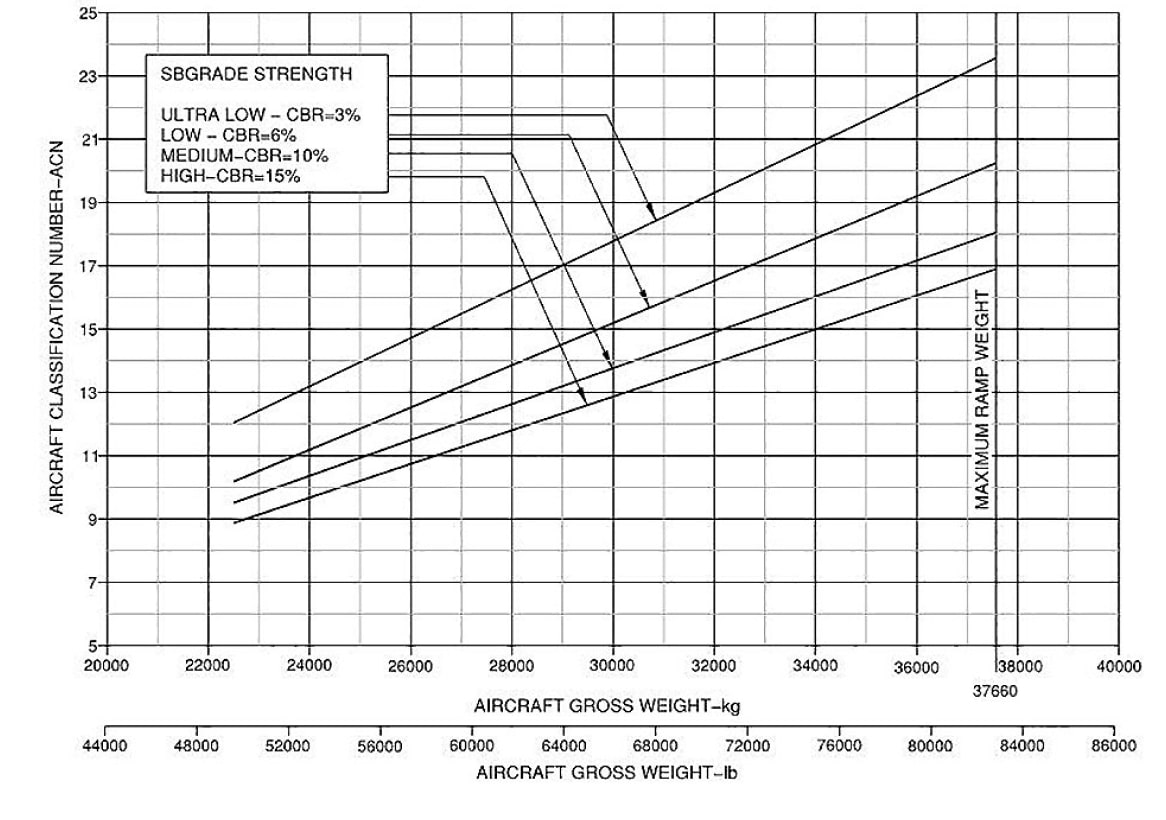
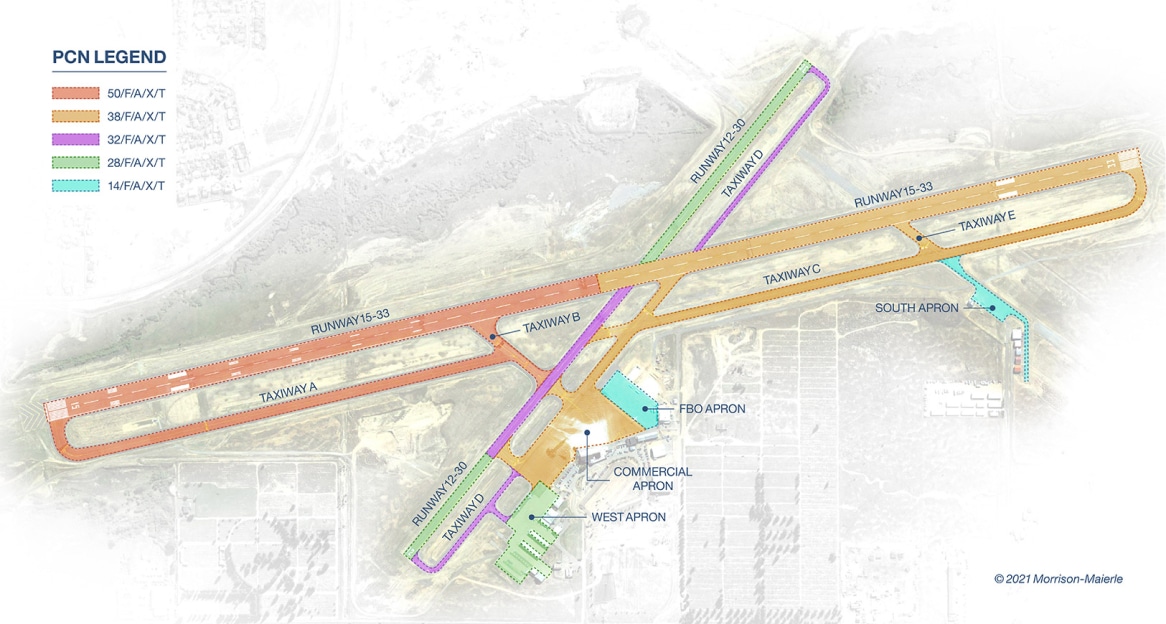
Let’s say your consultant has graciously provided a PCN code map of your airfield based on a subgrade category ‘B,’ and a table of ACNs for mix of aircraft that corresponds to your subgrade category at the airport. A charter pilot of a G-V calls to ask about pavement strength. You refer to your table and see that a G-V has an ACN of 28. Your PCN map indicates that your runway, taxiway, and apron have PCN codes of 30. In this case, since you have all flexible pavements, you would tell the pilot that your pavement strength is a 30/F/B/X/T. Since your PCN is greater than the ACN, your pavements can support the aircraft.
Conversely, the next day, you get a call from the pilot of a 737 who wants to fly in. Knowing your PCN is 30, you refer to the table and see that the 737 has an ACN of 45 for your subgrade category. If, after telling the pilot your PCN code, they still indicate they intend to land, this should raise a red flag, and you may want to clarify or have them verify their intentions. (See table above for both examples)
It is always good practice to report what the PCN code is for the pavement to the pilot and not specifically tell them your airport can support their aircraft. The pilot is responsible for determining whether they should use the airport, depending on a variety of factors, including reported pavement strength.
The ACN-PCN method for pavement strength can become complex depending on the variations in your airfield pavements, subgrades, and aircraft fleet mix. If you would like to discuss practical options and tools to help with pavement strength, please reach out anytime.
 In the past, the method for reporting pavement strength in the United States was based on gear configuration and aircraft weight. This was commonly reported as maximum single wheel, dual wheel, dual tandem, and double dual tandem, reported in thousands of pounds. If an aircraft had a specific gear configuration or an international pilot accustomed to a different standard or units, it was challenging to determine whether your pavement could support the aircraft.