Bend, Oregon
Lundy Ditch Piping Project
In Central Oregon, water reliability is economic reliability. With multiple partners and on a complicated timeline, the Lundy Ditch Piping Project south of Bend has modernized a nearly 100-year-old private irrigation lateral by converting approximately 4,000 feet of open, unlined ditch into a closed-conduit pipeline.
From the beginning of the project—consisting of a study, design plans, and the acquisition of easements—through construction, the Lundy Ditch Project required constant communication and coordination among multiple partners and landowners. The division of duties with a clear understanding, specifically among the Deschutes River Conservancy, the Deschutes Soil and Water Conservation District, and Morrison-Maierle, shows how multiple parties can create the best solution for landowners and irrigators.
Built on Partnership
Like any community-driven infrastructure project, this effort benefited from a strong team from the start through the final project walk-through, as seen in this video. The Deschutes River Conservancy, Deschutes Soil & Water Conservation District, Arnold Irrigation District, Morrison-Maierle, and adjacent landowners all played key roles.
From navigating the complex world of grant funding, pipeline alignment, irrigation delivery location, contractor procurement, and easement creation, the team worked together throughout the project for the benefit of everyone. Having a capable and solutions-oriented team helped ensure nothing was missed and that no concerns were left unaddressed.
The Problem
Before this project, the ditch crossed several properties, some with water rights associated with the ditch, some without. While the project is rooted in agricultural operations and the delivery of irrigation water, its benefits extend to adjacent landowners through a change in alignment that expands their usable lot space, and to nearby agricultural properties that demonstrate the benefits of an irrigation modernization project.
Before this project, the ditch meandered through porous volcanic rock and sandy soils, contributing to significant seepage and evaporation, with losses sometimes exceeding 40% of diverted water. The ditch also required frequent clearing, increasing maintenance for water rights holders. Private irrigation deliveries were not metered, leading to inconsistent on-farm delivery and conflicts among patrons.
Details and Services
-
Design of approximately 415 linear feet of pipe
-
Creation of an AID-compliant intake structure
-
Seven on-farm deliveries along the main section of Lundy Ditch
-
Project Administration Services
-
Engineering Design Services
-
Permitting
-
Bidding Services
-
Construction Administration Services and Close-out Documentation
-
Landowner Manual Creation and Design Services

With water delivery from the Arnold Irrigation District, the Lundy Ditch Piping project now delivers water to eight water deliveries in a buried, closed-conduit pipeline.

Testing an electromagnetic flow transmitter in an irrigation valve box.

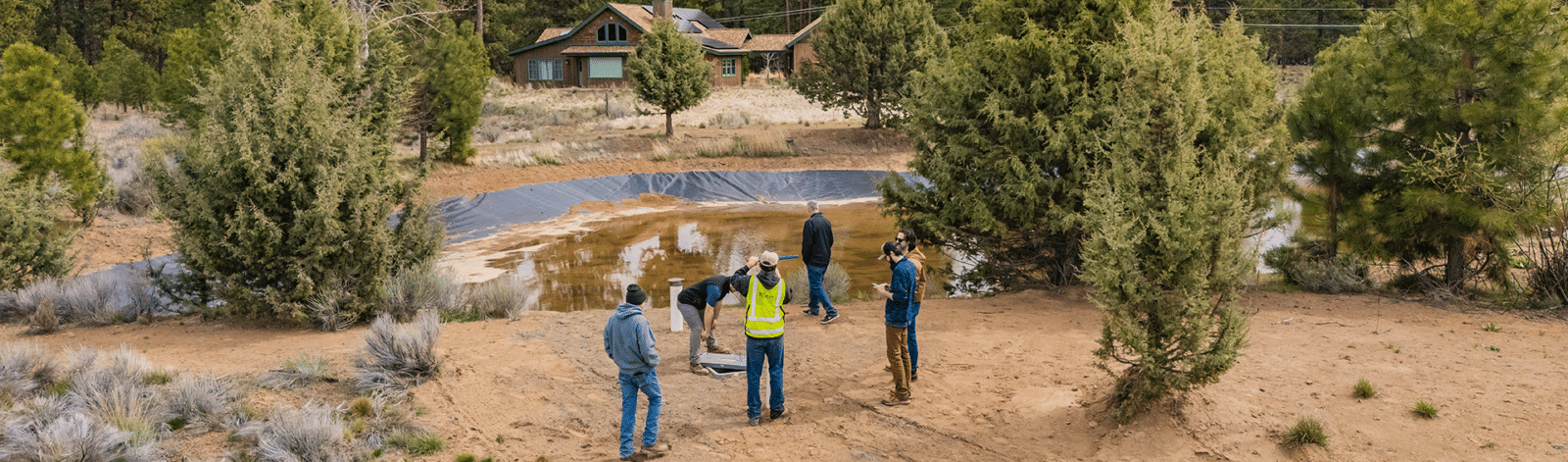
Several project team members gather around a ditch intake structure during a training session they provided for the landowners after the project was completed.
Benefits for the Land and its Owners
The Lundy Ditch Piping Project not only benefits the water right holders and adjacent landowners but also sets a pathway for the further advancement of irrigation modernization in Central Oregon in four main areas:
- Conservation of water while maintaining irrigation: Converting to a piped mainline delivery system allows each water rights holder to receive their water while preventing costly delivery losses.
- Lower maintenance disturbance: Fewer ditch cleanouts mean less time water rights holders need to spend cleaning the ditch, reducing impacts on neighbors and vegetation on their property.
- Clearer accountability and fewer disputes: Metering at the point of diversion on farms improves transparency, supports fair operations, and will lead to fewer potential conflicts.
- A pathway to future pressurized service: The design now supports eventual connection to the fully piped Arnold Irrigation District Main Canal, positioning patrons for future system upgrades, including the elimination of non-piped segments between the intake on the Deschutes River and the on-farm deliveries.
- Flow restored to the Middle Deschutes River: Arnold Irrigation District, in partnership with the Deschutes River Conservancy and through the state’s Allocation of Conserved Water Program, has restored 0.5 cfs of flow to the Middle Deschutes River.
Meet the Team